Help & advice · free guide

uPVC door won't lock or lift? Here's what's wrong

The short answer

When a uPVC door won't lock, it is almost always one of two things: the door has dropped out of alignment, so the hooks miss their keeps in the frame, or the multipoint gearbox inside the door has worn or failed. Open the door and lift the handle: if everything throws smoothly with the door open, it is alignment; if the handle is stiff or jams even then, it is the gearbox.

The handle won’t lift, the key won’t turn, or the door needs a shoulder before it locks. Before you call anyone or order a part, one quick test tells you what you are actually dealing with — and it costs nothing but ten seconds.

The ten-second test that tells you which fault you have

Open the door wide, take the weight off the hinges, and lift the handle in mid-air. If the hooks and bolts throw smoothly with the door open, the mechanism is healthy and the fault is alignment. If the handle is stiff, gritty, or jams even with the door open, the fault is the gearbox inside the door.

What does it mean if the door is out of alignment?

It means the door has physically moved relative to the frame, so the hooks no longer meet their keeps cleanly. Doors drop a few millimetres on their hinges over time, and uPVC moves with the seasons. The mechanism is fine — it is aiming at the wrong spot, and the cure is to move the door back.

You can usually read the story off the metal. Look at the keeps — the slotted plates on the frame that the hooks drop into. Bright rub marks above or below the slot tell you which way the door has shifted: shiny on the underside of the keep means the door has dropped and needs lifting; shiny on top means it has risen.

What does it mean if the gearbox is failing?

It means the centre case behind the handle — the part that turns your lift into the throw of every hook — is worn or broken, so no alignment will save it. A failing gearbox feels stiff with the door wide open, sometimes spins without engaging, or lifts but won’t return. This is a part replacement, not a tweak.

The multipoint strip is what makes a uPVC door secure and what makes this fault frustrating: one handle drives a row of hooks, rollers, and shootbolts along the whole edge. When the gearbox at the centre gives up, every locking point goes with it at once, which is why the door can pass the open-door test one week and fail it the next.

How do you tell a cylinder fault apart from all this?

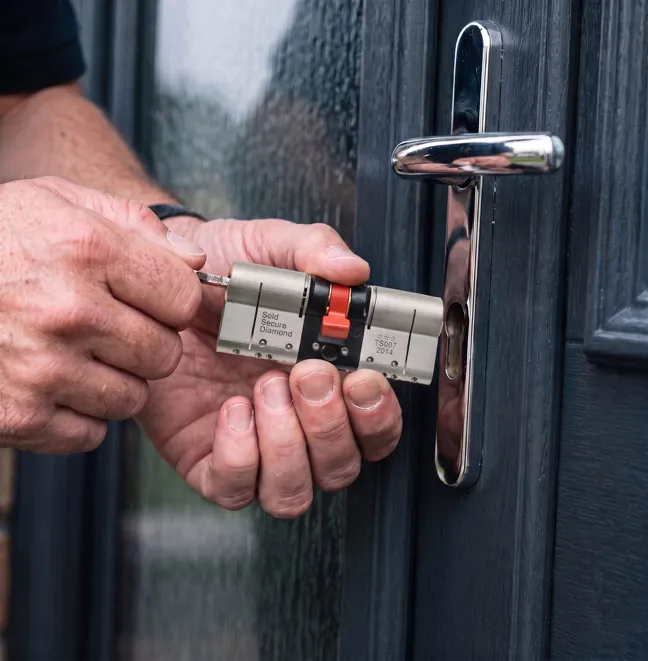
The cylinder is the barrel your key goes into, and it has a failure that is easy to confuse with the rest. If the handle lifts perfectly but the key won’t turn to deadlock, the cylinder is the suspect — not the gearbox, not the alignment. A snapped or seized cylinder is a quick, cheap swap.

What you feelMost likely causeWho fixes it
Handle lifts open, jams when shutAlignment — hooks miss keepsDIY tweak, or a quick pro adjustment
Handle stiff or jams even openWorn or failed gearboxLocksmith — matched part
Handle fine, key won’t turnCylinder seized or snappedLocksmith, or careful DIY swap
Door sticks only in cold monthsSeasonal movement on the hingesHinge adjustment for the full range

What can you safely try yourself first?

Plenty, as long as you stop at the first sign of force. Start with the cheap, reversible checks below; each one either fixes the door or rules a cause out, and none risks the mechanism the way slamming does. If you reach the end and it still won’t lock, that is the line for a locksmith.

  1. Test at a different time of day. A door that locks at 8am but not at 6pm is moving with the temperature — that is alignment, and it tells the locksmith exactly what to set.
  2. Lubricate the moving metal properly. A puff of dry PTFE or silicone spray on the hooks, rollers, and keeps — never oil or grease, which gum up with grit. Throw the handle a few times to work it in.
  3. Try the lift-and-pull. With the door shut, pull it firmly towards the hinges by the handle while you lift. If it locks, the door has dropped and wants a hinge adjustment — a lasting fix, not this daily wrestle.
  4. Check the hinge screws, gently. Modern flag hinges adjust in three directions with an Allen key. Quarter-turns only, one at a time, testing as you go. If you are not confident, leave this one — over-adjusting throws the seal as well as the lock.

When to stop and call a locksmith

Stop the moment a fix needs force, or the moment the handle feels wrong with the door open. Specifically: call when the handle is stiff or jams in mid-air (gearbox), when the door only locks if you lean on it, when the key won’t turn though the handle lifts (cylinder), or when you have adjusted the hinges twice and it still won’t settle. Forcing it past these points is how a cheap repair becomes a replacement.

A genuine fix here is almost always a repair, not a new door. A matched gearbox, a fresh cylinder, or a proper realignment restores the door you already have — so be wary of anyone who quotes a whole new door for a fault the open-door test pins to one part.

The short version, if you skipped to the bottom

Open the door and lift the handle. Smooth means alignment — try lubrication, the lift-and-pull, and a gentle hinge tweak. Stiff or jammed even open means the gearbox, and a key that won’t turn while the handle lifts means the cylinder. Both of those are a repair to the door you already have, not a new door — and stopping before you force it is what keeps it that way.

Questions people ask us

Why does my handle lift with the door open but not when it's shut?

That points to alignment, not the mechanism. With the door open there is nothing for the hooks to push against, so they throw freely. Shut, the hooks meet keeps that have shifted out of line — usually because the door has dropped on its hinges or moved with the seasons.

Is it safe to keep using a door I have to slam to lock?

Not for long. Every forced lift drives a worn gearbox harder and bends the hooks against misaligned keeps. A door you can still lock with a shove today can fail shut tomorrow, with you on the wrong side of it. Treat slamming as a warning, not a workaround.

Can I just replace the cylinder myself to fix this?

Only if the fault is genuinely the cylinder — a key that won't turn while the handle lifts fine. If the handle itself is stiff or the hooks miss their keeps, a new cylinder changes nothing: the problem is the gearbox or the alignment behind it, and swapping the cylinder wastes the part and your afternoon.

How long does a multipoint gearbox repair take?

A straightforward gearbox swap is usually under an hour once the part is matched. The honest variable is the part itself: there are dozens of gearbox patterns, so the centre case has to be measured before anyone can promise to finish in one visit. We confirm the part and the price on the phone before setting off.

My door locks fine in summer but sticks every winter — why?

uPVC shrinks in the cold, roughly 0.8mm per metre for every 10°C drop, so a door that sits borderline in July tips into sticking in January. The lasting fix is a hinge adjustment set for the middle of the range, not a seasonal tweak you redo twice a year.

If it comes to it

Want a number instead of a theory?

One call: describe the door, get a fixed quote, decide in your own time. no call-out fee — when you accept the quoted work.

Send a photo on WhatsApp (opens WhatsApp)
  • You'll have your price in writing before we set off.
  • 8am until midnight, seven days a week

Sources

  1. British Standards Institution — BS 3621 thief-resistant locks — bsigroup.com
  2. Glass & Glazing Federation — uPVC door maintenance guidance — ggf.org.uk
  3. Which? — Door locks buying guide — which.co.uk