You’ve decided to upgrade your lock. You’ve chosen a quality anti-snap cylinder. You’ve even found a good price. Then it arrives—and it doesn’t fit. Too long. Too short. Wrong offset. Now you’re waiting for a return and reorder while your door remains unsecured.
This happens constantly. Getting Euro cylinder sizing right is straightforward once you understand the system, but the measurement conventions aren’t intuitive. This guide ensures you order correctly first time. If you’re not sure whether to do this yourself, read our DIY vs professional fitting guide.
Euro cylinders are measured in millimetres as internal length + external length (e.g., 40/50). To measure: remove your current cylinder, measure from the centre screw hole to each end, and note which measurement is internal vs external. The external section should not protrude more than 3mm beyond your door furniture to prevent attack grip.
Understanding the Sizing System
The Two-Number Format
Every Euro cylinder is described by two numbers: internal/external.
For example, 45/50:
- 45mm from the centre fixing hole to the inside of the door
- 50mm from the centre fixing hole to the outside of the door
- 95mm total length (45 + 50)
The centre point is where the fixing screw passes through—this is the reference for all measurements.
Why Two Numbers Matter
Doors aren’t symmetrical. The inside often differs from the outside due to:
- Handle furniture thickness differences
- Decorative panels or cladding
- Weather seals and architraves
- Door thickness variations
A cylinder that’s 40/50 is significantly different from one that’s 50/40—same total length, opposite orientation.
How to Measure Your Cylinder
Method 1: Remove and Measure (Recommended)
This is the only way to get accurate measurements.
Step 1: Remove the cylinder
- Open your door
- Locate the fixing screw—it’s on the door edge, pointing into the lock mechanism
- Remove the screw completely
- Insert your key and turn slightly to retract the cam (the tail piece)
- Pull the cylinder through from either side
Step 2: Find the centre
- Look for the screw hole that runs through the cylinder (where the fixing screw sat)
- This is your measurement reference point
Step 3: Measure both sides
- From centre hole to one end: note as “A”
- From centre hole to other end: note as “B”
- Identify which end faced inside and which faced outside
Step 4: Record correctly
- Write as internal/external (e.g., 40/50)
- The first number is always the inside measurement
Method 2: Measure in Place (Rough Measurement Only)
If you can’t remove the cylinder:
- Measure from the centre of the external keyhole to the outside door surface
- Measure from the centre of the internal keyhole (or thumbturn centre) to the inside door surface
- Add approximately 3mm to each measurement to account for protrusion
This method is less accurate and not recommended for ordering. Use it only as a preliminary rough measurement. To understand why proper sizing protects against lock snapping attacks, read our detailed guide.
Common UK Sizes
Most residential doors in the UK use a limited range of cylinder sizes.
Standard Sizes
| Size | Total Length | Common Application |
|---|---|---|
| 35/35 | 70mm | Thin uPVC doors, some composite |
| 40/40 | 80mm | Standard uPVC, many composite doors |
| 40/45 | 85mm | Common composite door size |
| 45/45 | 90mm | Standard composite, some wooden doors |
| 45/50 | 95mm | Thicker composite doors |
| 50/50 | 100mm | Wooden doors, thick composites |
When Offset is Common
Offset cylinders (different internal/external lengths) are typical when:
- The external handle furniture is thicker
- Decorative panels add depth to one side
- The door has external weather protection
Common offset patterns: 35/45, 40/50, 45/55
The Protrusion Rule
This is critical for security.
Why Protrusion Matters
A cylinder that sticks out beyond the door furniture provides leverage for attack tools. Lock snapping becomes easier when criminals can grip the protruding cylinder.
The 3mm Maximum
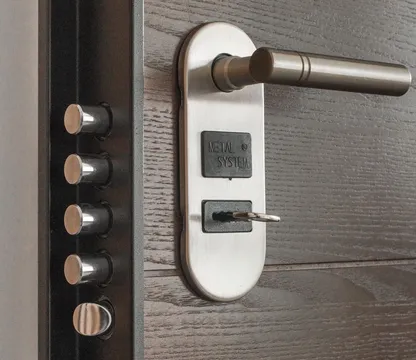
The external end of your cylinder should protrude no more than 3mm beyond the door handle or escutcheon plate.
- Flush or slightly recessed: Ideal—nothing to grip
- 1-3mm protrusion: Acceptable
- More than 3mm: Security risk—incorrect sizing or poor furniture fit
Checking Protrusion
After fitting, check visually:
- Is the cylinder face roughly level with the handle plate?
- Can you grip the cylinder end easily?
- Does it stick out noticeably?
If it protrudes significantly, you have the wrong size or incompatible door furniture.
Thumbturn vs Double Cylinder
Choosing between these affects measurements and safety.
Double Cylinder (Key Both Sides)
- Key required to operate from both inside and outside
- Maximum security—can’t be opened by reaching through letterbox or broken glass
- Fire safety consideration: Occupants need access to key for emergency exit
Thumbturn Cylinder (Key Outside, Turn Inside)
- Key operation from outside, thumb-operated knob inside
- Allows key-free exit in emergencies
- Slightly reduced security—can be operated if intruder gains internal access
The Safety Question
Measurement Difference
Thumbturn cylinders are measured the same way—centre to each end. The thumbturn doesn’t affect the size specification, only which end goes where during installation.
Special Situations
Very Thick Doors
Some doors—particularly older wooden doors or heavily insulated composite doors—exceed 100mm total thickness.
Options:
- Source longer cylinders (some manufacturers offer up to 55/55 or 60/60)
- Use cylinder extenders (available for some ranges)
- Consult a locksmith for alternatives
Very Thin Doors
Doors under 70mm total may need 30/35 or 35/35 cylinders. These are available but less common.
Concern: Very short cylinders may have reduced internal complexity. Ensure any short cylinder still has full security features.
Unusual Door Furniture
If your handle or escutcheon has unusual thickness or recessing:
- Measure to the outer face of the furniture, not the door surface
- The cylinder needs to be flush with the furniture face, not the door
Multipoint Lock Systems
Most multipoint locks use standard Euro cylinder profiles. However:
- Some older multipoint locks have proprietary cylinders
- Measure carefully before ordering
- If in doubt, note your lock brand and consult the manufacturer
Ordering Checklist
Before purchasing:
- ✅ Measured from removed cylinder (not roughly gauged in place)
- ✅ Know which measurement is internal vs external
- ✅ Confirmed total length matches door thickness
- ✅ External side won’t protrude more than 3mm
- ✅ Decided thumbturn vs double cylinder
- ✅ Confirmed 17mm diameter (or measured if unsure)
- ✅ Selected appropriate security rating (TS007 3-star recommended)
What If You Order Wrong?
It happens. Here’s how to handle it:
Too Long
- Do not fit—protrusion creates a security risk
- Return and exchange for correct size
- Never file or cut a cylinder (compromises security features)
Too Short
- If 1-2mm short, usually acceptable
- If significantly short, the cylinder may not engage properly
- Return if the cam doesn’t operate the lock when fitted
Wrong Orientation
- The cylinder will fit but protrusion will be wrong on both sides
- Return if this creates more than 3mm external protrusion
- Accept if protrusion remains minimal and flush on the external side
Take Action
Grab a screwdriver. Remove your cylinder. Measure both sides from the centre screw hole. Note which is internal and which is external. Check your current protrusion.
With these measurements in hand, you can order confidently—knowing your new cylinder will fit correctly, sit flush, and provide the security you’re paying for.
Getting sizing right isn’t complicated once you understand the system. Fifteen minutes of careful measurement saves days of waiting for exchanges and ensures your upgrade happens smoothly.